
My American Sail - Sailing Page
Come with me as I teach myself how to
Sail and use my American Sail 14.6 sailboat.

Up Dated September 2011
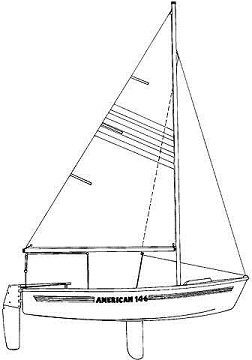
American Sail 14.6 Sailboat.
(Photo Credit Unknown)
NOTE: This blog is in chronological order, so the oldest post is listed first. To see the NEWEST ENTRY - GO TO PAGE FOUR? DISCLAIMER listed at the bottom of the last page along with contact info.
About a year ago (: summer 2008,) I finely decided to take the plunge and learn to sail. I had looked long and hard before deciding on what became my first sail boat, the American Sail 14.6, which I purchased used. When asked, the folks at American Sail sent me an instruction sheet-owners manual which came in handy when trying to figure out how to rig the boat.Stag Harbor Sailing offers an excellent two day intensive-hands on course that taught me the basics of small boat handling and sailing. It was money well spent (. Video at: http://www.youtube.com/watch?v=tCDPT_MGo3o ). On my own, I spent some time learning to back up the boat, raising the mast and setting the sails before taking the boat out. The first couple of times I just drove around the inlet using a 3.5 horse power outboard motor.
Me, enjoying the Waters of Smithtown Bay.

That white line you see going from the boom to the top of the mast is the topping lift.
It is now my second summer and with all the rains I have managed to get the boat out on the water just a hand full of times. I would pass along some words of wisdom, but I don’t have any. I am still very much the novice. One of the few things I have done was to install a "Toping Lift", a line that runs from the top of the mast to the back of the boom. It keeps the boom suspended in the air (, and out of the way), plus it makes it easier to raise and lower the.sail.
The factory offers the topping lift as an option on new boats and even after corresponding with them I am uncertain if they offer it as a retrofit upgrade-kit. But I came across an excellent article on the Internet, on how to DYI (: Do It Yourself) “Install a Topping Lift“. I wish I knew who to give credit and thanks to on that. Total cost was about $30.00 and excluding the running around, took maybe 20 minutes.And while the factory concept of using a towel at the back of the boat to rest the mast on works, I wanted something better. So I built a “Mast Crutch” which is very much a work in progress. I currently am on design # three. If I come up with something better, I will post it here.
One of my first concerns when I first got started last year with the sailboat was putting up and taking down the darn mast. They always make it look so simple on the videos they post on the internet. Its a bit of work and dispite what they show on the internet, its a job better done by two people instead of the one person shown. A better way is needed.I started experimenting using a pulley and a rope. And I also tried creating my own jib boards and poles as well. Nothing I tried works well. One bit of good news, the more often you do it the easiler it becomes. Its still arkward however. (. PS: The same problem exists with all sailboats).
Still I am experimenting. If I come across something better you will see it here. As I found out, you need to keep an oar or paddle with you. If you have the outboard quit on you, or if you have to “Fend Off” to keep from a collision with another boat, well it comes in handy. Also a tow line. Where I sail is thankfully well traveled. But you can not count on the kindness of strangers to rescue you if you get stranded.
I joined BoatUS as twice now the outboard let me down and I needed a tow and was not in a position to use the sails. The Long Island Sound is a big body of water that can get quite nasty. I have been on the Sound (while on the Ferry) during Lightning Storms. Even Smithtown Bay can be dangerous. So you got to know that I wear my PDF (: Life Vest).
To date I have not gone so far that I could not see the shore, but I know that I will eventually go out past that point. With that in mind, I Keep a large compass in my life vests pocket. Most of my friends however use a water proof GPS. Last year, every time I backed the boat into the water I would short out my trailers tail lights. So on one of my many trips to the West Marine store, I picked up a set of submersible tail lamps (, for about $ 40) and installed them. End of problem.As you can see, the 14.6 is not exactly a small boat.
The American Sail is proving to be a very robust boat, and I like the fact that it will float in as little as 4inches of water. A few times last year I was one of the few boats getting in and out of the local inlet at low tide. The motor on my boat is a Tohatsu 3 ½ hp, short shaft which I bought used (supposedly it was about 8 months old and used less than a dozen times when I got it). Last year it ran like a champ, but I have had my share of trouble with it this year. All of which can be attributed to my lack of experience, I try not to make the same mistake twice.
This motor seams like a good pick for someone like me who is just starting out. Not too complicated and easy to operate. During this past winter I have picked up a Nordica 16 boat as well, so be sure to check it out on the net, and if you like flying check out my adventures on http://the.quest.for.wings.tripod.com/ .
Note: This web page moved from prior location due to web site close out.
A NEW SEASONHave you ever wanted to learn to sail? Well that was me. And it still is. While I am learning I have no claims to being knowledgeable or skilled. This is my second summer a float. Last year I purchased my first sailboat and took two days of lessons before heading out into the long island sound.

The 14.6 rigged and ready to go.
One of the first things I done was to learn to rig the boat. The instructions from American Sail was very useful. I have found that a boat should have (in addition to some ropes, a fire extinguisher, first aid kit, flares, compass, map, flashlight, knife, horn or whistle and PFD’s for everyone on board) a paddle, some way of bailing water, and an anchor. And since it is so easy to capsize in a small boat, some means of securing it all.While I am sure that any boat can be capsized every one I have spoken or corresponded with (on the subject) tells that the American Sail is hard to capsize and easy to up right if there was a problem. At the end of summer last year, I picked up a Midland (two way, water resistant) hand held radio. I didn’t do it so I could yak with other boats, but so I could call for help if I get into trouble and for weather updates.
This past week, we went out fishing on the South shore. There was lots of chop and boats under 14 feet were not allowed. Most of the boats there were powerboats. A few weeks ago we checked out Lake Ronkomia and the states public boat ramp there. We saw one boat, but there were a few trailers so most have been more we didn’t see. No gas motors allowed there.
Life goes on.


Updated: Friday, 23 September 2011 8:16 PM EDT
Post Comment | Permalink | Share This Post